Catalyst Discovery
Catalyst discovery
Homochiral catalysts that can effect asymmetric transformations are invaluable in the production of optically active molecules. The development of efficient chiral metal complex catalysts modified with various chiral ligands and chiral organocatalysts is a significant endeavor in asymmetric catalysis. Our group has developed several new classes of small-molecule chiral catalysts and chiral ligand-metal complex catalysts. The general schemes are outlined here, and specific examples and application can be found in the asymmetric catalytic reaction gallery.
Asymmetric Catalysis with Chiral N,N’-Dioxides
Based on the strategies of bifunctional catalysis and C2-symmetry, we designed and synthesized a new family of N,N'-dioxide amide compounds from easily available amino acids and amines. Novel C2-symmetric N,N'-dioxides were readily prepared by the connection of two N-oxide amide subunits via a linker with variable conformation. The structural modify to fit the targeted enantioselective reactions could be easily established by using different chiral backbone, linker units, and amines with varied steric and electronic nature.
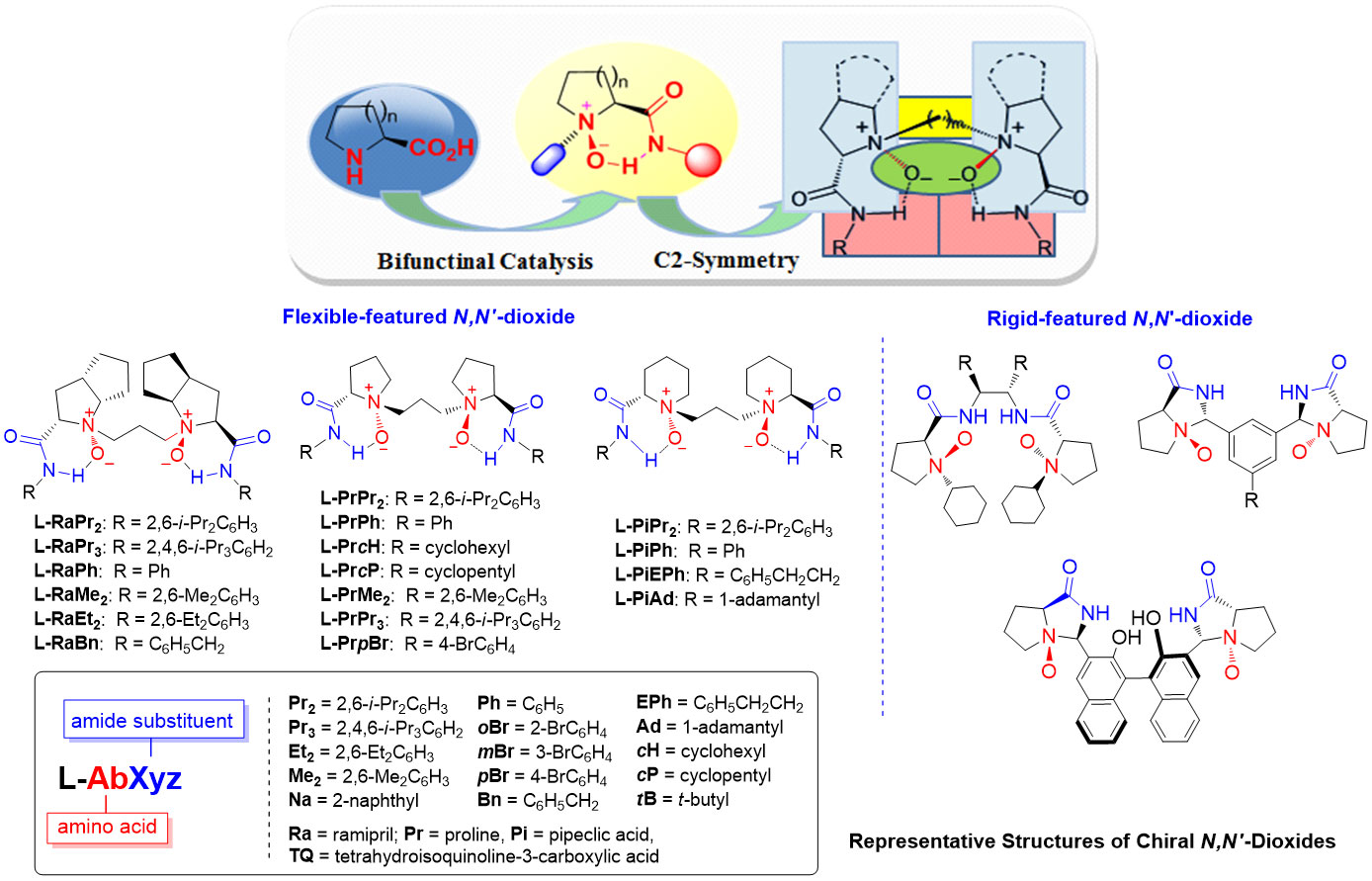
The first application of chiral N,N’-dioxide involves bifunctional organocatalysis----amine-oxide acting as Lewis basic group and amide providing hydrogen bonding with concomitant enhancement of both electrophilicity and nucleophilicity. The second involves chiral ligand-metal complex catalysis. Numerous chiral tetradentate ligand-metal complexes have been established as effective catalysts (see Acc. Chem. Rev. 2011, 44, 574 for details).
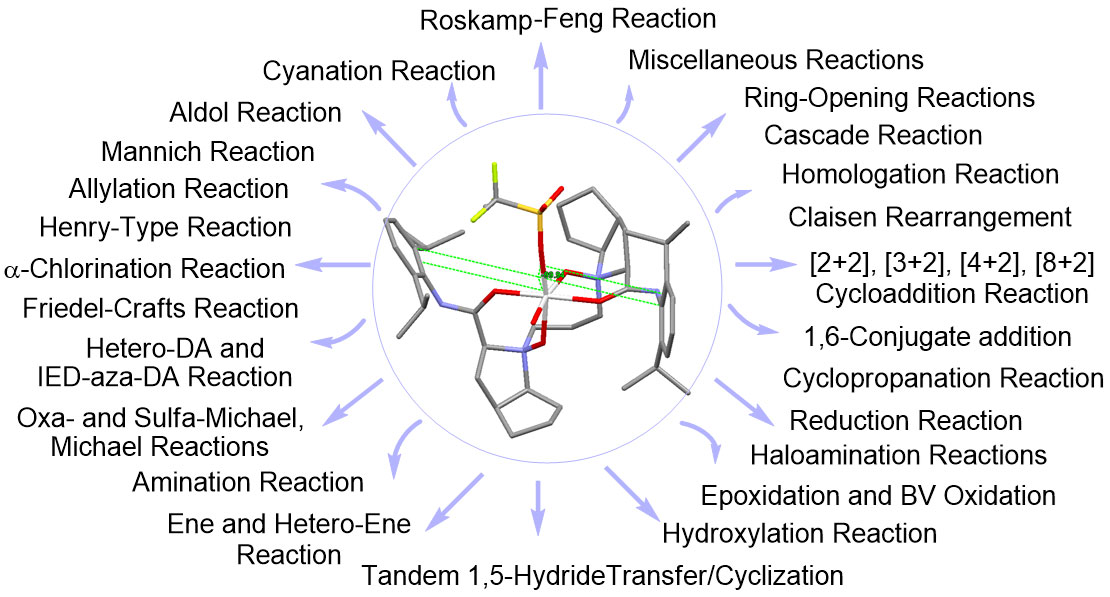
The second utility of this kind of compounds is greatly expanded by using them as privileged ligands for Lewis acid-catalysed asymmetric reactions. N,N'-dioxide amides efficiently coordinate with various metal salts, such as rare earth metals, alkaline earth metals, group IV metals, group XIII metals. In the presence of an appropriate metal ion, the intramolecular hydrogen-bonds of the N,N′-dioxide disappear, and thereafter, the amide and amine oxide moieties could switch laterally and inwardly to coordinate to the metal center due to the configurational freedom of the sp3 α-carbons and alkyl spacer. More than forty types of asymmetric catalytic reactions can be catalyzed by N,N′-dioxide–metal complexes under mild reaction conditions with simple procedures. The issues of the control of regioselectivity, diastero- and enantioselectivity of the reaction are well addressed.
Note: Both enantiomers of the ligands is commercially available from J&K Scientific Ltd.

Asymmetric Catalysis with Chiral Chiral Guanidine
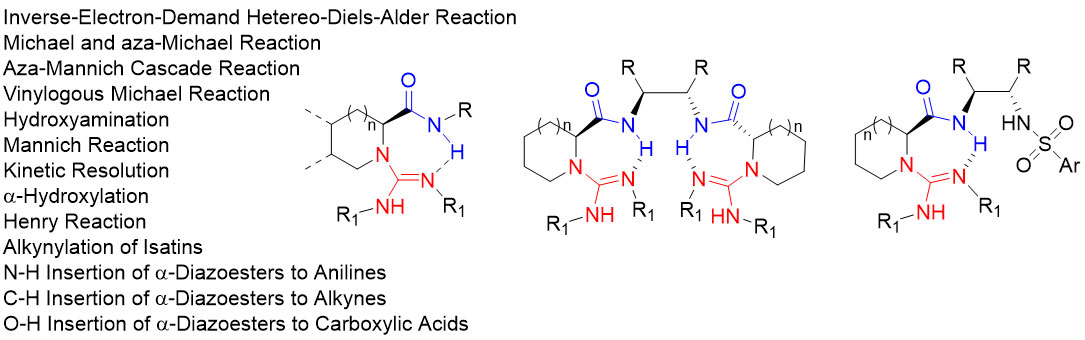
Guanidines which contain one Y-shaped CN3 moiety with a special delocalization behavior are categorized as organosuperbase. We designed and synthesized a new type of chiral acyclic guanidine-amide compounds from chiral amino acids. Chiral guanidine, bisguanidine and its hemi-salt, as well as guanidine-amide have been developed as bifunctional organocatalysts in several reactions. We also extended the chiral acyclic guanidines in metal complexes catalyzed asymmetric reactions.
Asymmetric Catalysis with Chiral Bispidine-based Diamine
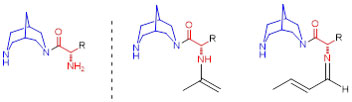
Bispidine as the structural core of sparteine opened up the opportunity to develop a new catalyst by introduction of an appropriate chiral group. Primary-secondary diamine organocatalysts, embedded in the bispidine/amino acid skeleton, were shown to be very effective in the direct aldol reaction between acetone and functionalized ketones, Michael reaction of nitroalkenes with acetone, butanone, and cycloketones.
Asymmetric Catalysis by Chiral self-assembled metal complex catalysts
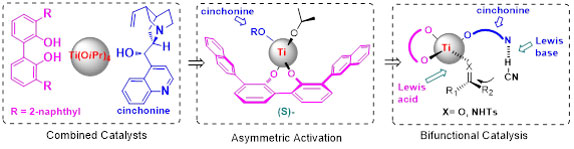
The concept of “asymmetric activation” provides an economic method for chiral catalyst designation, which has been proven efficient in many asymmetric transformations. We developed an assembled metal complex consisting of cinchonine, achiral biphenol derivative and Ti(OiPr)4. The key is the use of a flexible biphenol ligand in combination with a readily available chiral modifier. The atropos ligand is influenced by the chiral modifier and directs the ligand to the most stable conformation, which then defines the enantio-discrimination of the catalytic center. This combined catalyst shows a wide substrate tolerance, by which highly efficient and enantioselective cyanation of C=O, C=N, and C=C bonds were consistently realized.
Asymmetric Catalysis with Chiral Organic salts
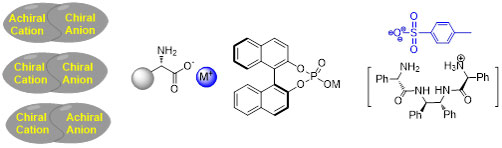
Salt catalysts, especially chiral functionalized salt catalysts open an interesting sub-field of asymmetric catalysis due to their tunable features for various chemical tasks, their advantages in a convenient recovering and reusing process, and their possibilities in relation to structural modification of either the cation or anion. We demonstrated that chiral alkali-metal salts, such as sodium phenylglycinate, sodium phosphate, and chiral amine salts could serve as efficient catalysts for several types of reactions.