Recently, the Bo Lai/Zhaokun Xiong team from the College of Architecture and Environment published a research paper entitled "Long-range interactions driving neighboring Fe–N4sites in Fenton-like reactions for sustainable water decontamination" online in Nature Communications. Ph.D. Wu Zelin and Associate researcher Xiong Zhaokun from the College of Architecture and Environment are the co-first authors of the paper, and Professor Lai Bo of Sichuan University and Professor Zhan Sihui of Nankai University are the co-corresponding authors. The College of Architecture and Environment of Sichuan University is the first corresponding institution.
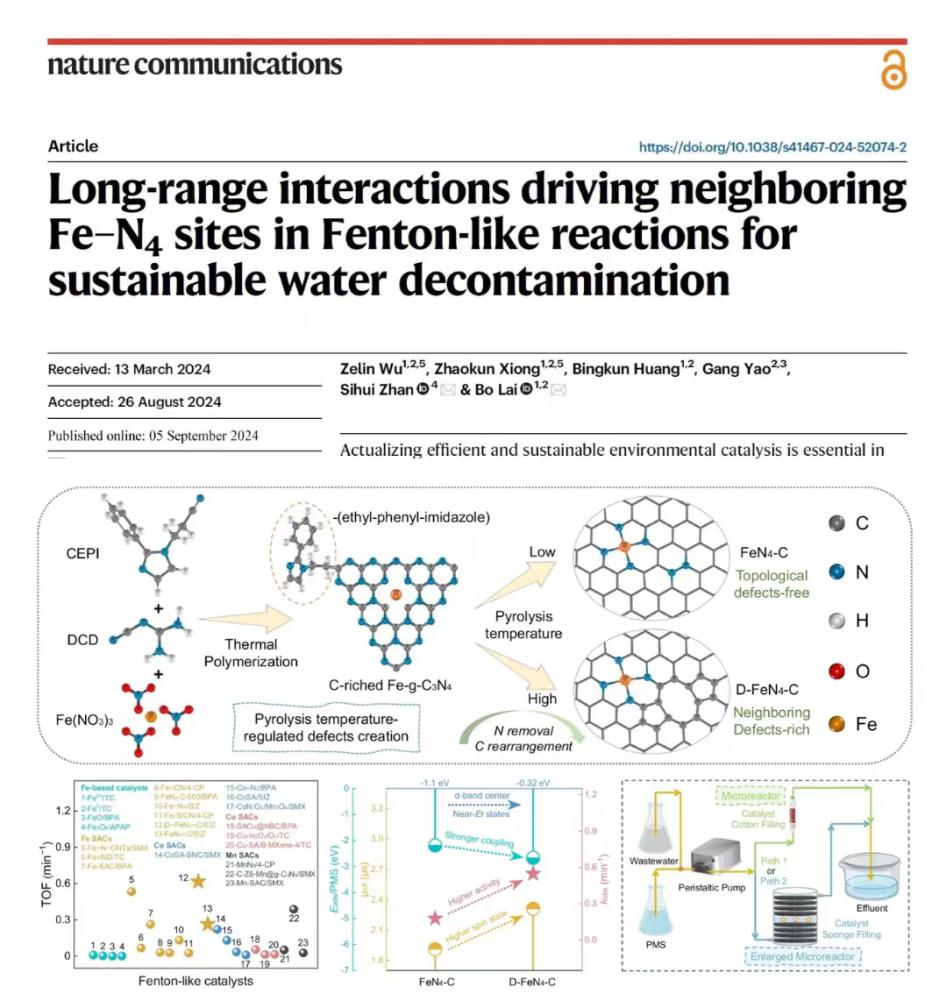
Actualizing efficient and sustainable environmental catalysis is essential in global water pollution control. In recent years, single-atom catalysts (SACs) have been applied to basic research and practical applications of peroxymonosulfate (PMS)-based advanced oxidation processes (AOPs) due to their many unique properties. SACs based on different metal centers and supports have been designed to activate PMS to generate various reactive oxygen species. However, the high production costs and energy consumption caused by the cumbersome synthesis of SACs and the potential environmental impact of toxic chemicals remain challenging. In addition, for carbon-based SAC based on Fe−N−C configuration, how to further improve the intrinsic activity and stability of SACs by manipulating long-range nonmetallic functionalized species beyond the first coordination shell remains to be studied.
This study designed a high-performance SAC by constructing abundant intrinsic topological defects within carbon planes anchored with Fe−N4sites, which exhibited excellent Fenton-like reactivity and enhanced stability in PMS activation. Low-cost and environmentally-friendly assembly strategies can control defect generation by modulating N species elimination without altering the local coordination environment of Fe−N4sites. The coupling of intrinsic defects and Fe–N4sites exerts a strong synergistic effect and significantly enhances PMS activation. Density functional theory calculations show that the long-range interaction between intrinsic defects and Fe–N4sites improves the intrinsic activity and stability of Fe–N4sites and promotes the formation of high-valent FeN4=O by optimizing the d-band structure of metals. Life cycle assessments and long-term stable operation at the equipment level demonstrate the environmental feasibility of the catalyst and good actual hospital wastewater treatment capacity. In summary, this work highlights the feasibility of synergistic defect engineering for refining single-atom Fenton-like chemistry and inspires rational material design to achieve sustainable environmental remediation.
This research was supported by the National Natural Science Foundation of China, the National Key R&D Program of China, and the Science and Technology Program of Sichuan Province.
Link to paper: https://www.nature.com/articles/s41467-024-52074-2




